Table of Contents
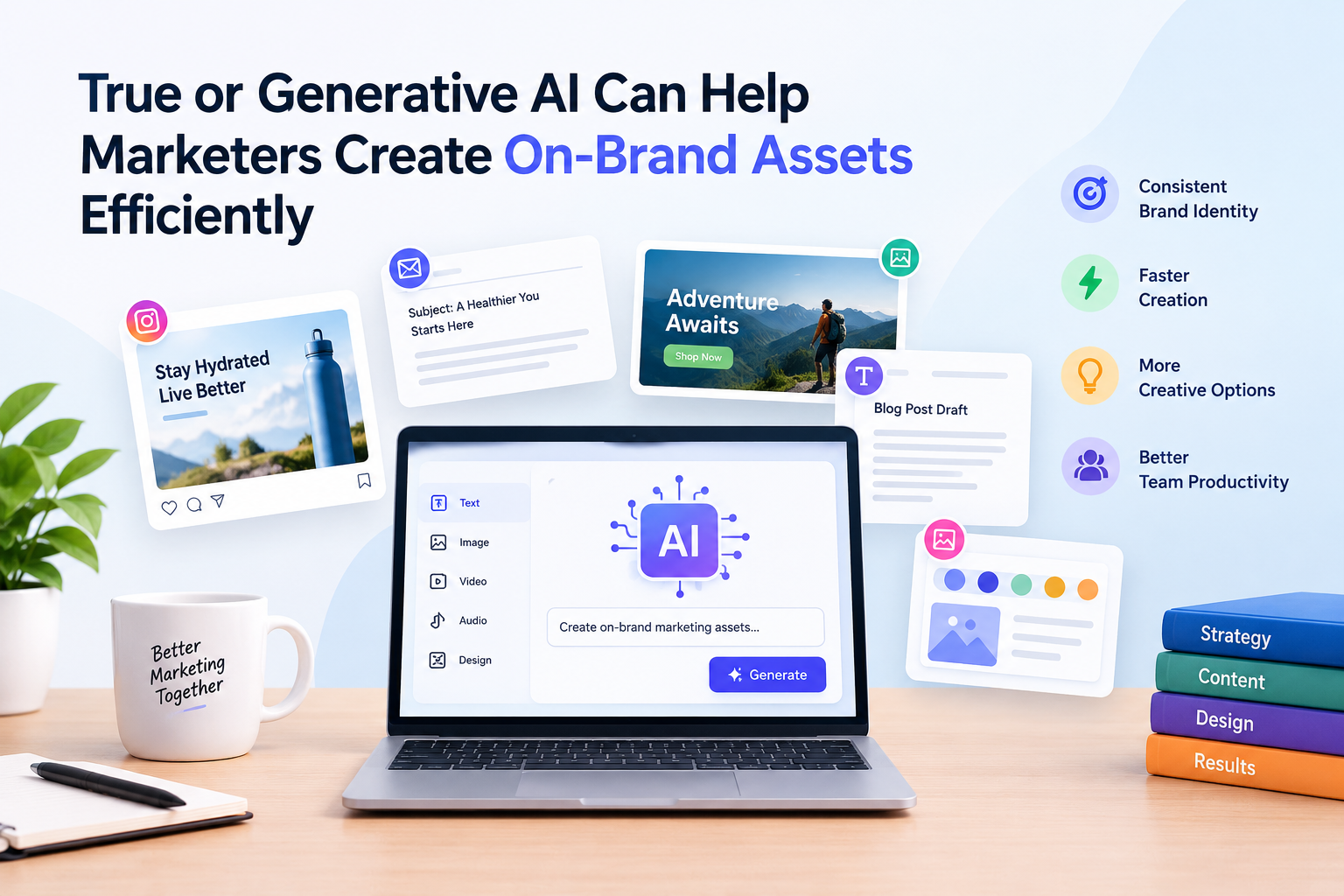
How Generative AI Helps Marketers Create On-Brand Assets is changing how marketing teams develop content, design campaigns, and maintain a consistent brand identity. From social media graphics to email campaigns and product visuals, marketers can use AI to create first drafts, explore creative ideas, and adapt existing messages for different audiences.
However, creating an asset quickly doesn’t automatically make it effective. The best results come when marketers combine AI-generated ideas with clear brand guidelines, human judgment, and a reliable review process.
This guide explains what generative AI is, how it differs from traditional AI, which tools marketers can use, and how to build an efficient workflow without losing the qualities that make a brand recognizable.
What Is Generative AI and How Does It Work?
What is generative AI? It’s a type of artificial intelligence that generates new content based on patterns learned from training data and instructions provided by a user. Depending on the model, that content can include text, images, audio, video, computer code, or combinations of these formats.
For example, a marketer could ask an AI tool to draft three email subject lines, create concepts for a product advertisement, or turn a campaign brief into a social media post. The tool generates possible outputs, which the marketer can then review and refine.
Generative AI Helps Marketers Is Best Described as a Content-Generation Technology
Generative AI is best described as a technology that produces new content in response to prompts or other inputs. It doesn’t simply retrieve a finished answer from a database. Instead, it generates an output using patterns learned during training and the context available to it.
Different models specialize in different tasks. Large language models generate and analyze text, while image-generation models create visuals. Multimodal models can work across several formats, making them useful for marketing workflows that combine copy, images, and other creative assets.
What Is AI, and How Is It Different From Generative AI?
Artificial intelligence, or AI, is the broader field of developing computer systems that perform tasks associated with human intelligence. These tasks include recognizing patterns, classifying information, making predictions, understanding language, and generating content.
Generative AI falls within this broader field, but not every AI system generates content. A system that predicts which customers are likely to respond to an offer uses AI without necessarily generating anything new.
Generative AI vs. AI: Understanding the Difference
The terms generative AI vs AI and AI vs generative AI describe the same comparison. The key distinction is between the broader category of AI and one group of technologies designed to generate content.
| Feature | Traditional or Predictive AI | Generative AI |
|---|---|---|
| Primary purpose | Analyze information, classify data, or make predictions | Generate new content |
| Marketing example | Predicting which leads may convert | Drafting personalized sales emails |
| Common outputs | Scores, classifications, forecasts, and recommendations | Text, images, audio, and other creative assets |
| Main value | Supports analysis and decisions | Supports content creation and creative exploration |
| Human oversight | Needed to interpret results and make decisions | Needed to review output, accuracy, and brand fit |
Many marketing platforms combine both approaches. A campaign system might analyze performance data to identify an audience, then use generative AI to develop creative variations for that audience.
How Generative AI Models Produce Content
Generative AI models learn statistical patterns and relationships from training data. When you submit a prompt, the model uses that context to produce a response.
A useful way to think about it is as a creative assistant that works from instructions rather than intuition. The more relevant context you provide, the easier it becomes to guide the output toward your intended result. Still, detailed prompts don’t guarantee accuracy, originality, or brand consistency.
For marketers, the practical lesson is simple: AI output is a starting point, not an automatic substitute for professional review.
How Generative AI Can Help Marketers Create On-Brand Assets Efficiently
Brand consistency means making every customer interaction feel like it comes from the same organization. Your social media posts, website copy, email campaigns, product images, and advertisements should share a recognizable voice and visual identity.
Generative AI can help teams maintain that consistency while producing more creative options. Marketers can use it to draft copy in a defined tone, adapt campaign messages for different channels, generate image concepts, and repurpose existing content. Google’s AI tools for marketing page describes practical applications such as drafting campaign messages, creating visuals, analyzing information, and automating repetitive tasks.
How AI Helps Marketers Create Content Faster
Consider a small business preparing to launch a new skincare product. The marketing team needs a product announcement, three social media posts, an email, and a landing page introduction.
Without AI, a marketer might draft each asset separately. With an AI-assisted workflow, the marketer can start with one approved campaign brief and generate initial drafts for every channel. The team then edits those drafts to match the audience, platform, and campaign objective.
This approach is especially useful for repetitive work, such as producing multiple headlines, adapting copy to different formats, or turning a long article into shorter promotional content. Ai Now a Days Helping in Many Sectors and Industries to increase the productivity.
How Brand Guidelines Shape AI-Generated Assets
AI needs direction to produce content that fits a particular brand. A useful brief should include the target audience, brand personality, approved terminology, messaging priorities, and words or claims to avoid.
Visual projects also need clear instructions. These might cover color palettes, typography, logo placement, image style, and composition. When a tool supports reusable brand assets or reference images, marketers can use those features to reduce inconsistency.
However, a prompt alone won’t guarantee that every output follows the rules. Teams should review the final content and use approved templates wherever precise visual consistency matters.
Why Human Oversight Still Matters
A brand is more than a logo and a set of colors. It reflects the company’s values, customer relationships, reputation, and understanding of its audience.
AI can generate polished-sounding copy that includes an unsupported claim or create a visually appealing image that misrepresents a product. Human reviewers need to catch those problems before publication.
A reliable process assigns clear responsibilities: AI helps with drafts and variations, marketers check the message, designers refine visual details, and authorized reviewers approve sensitive or high-impact content.
What Marketing Assets Can Generative AI Create?
Generative AI supports several parts of the marketing process, from early brainstorming to final creative variations. The exact capabilities depend on the tool, model, and available editing features.
| Asset type | Practical use | What to review |
|---|---|---|
| Social media content | Captions, post concepts, and promotional graphics | Brand voice, platform fit, and visual consistency |
| Advertising creatives | Headlines, descriptions, and image concepts | Claims, audience relevance, and advertising policies |
| Blog content | Outlines, first drafts, and content summaries | Accuracy, originality, search intent, and usefulness |
| Email campaigns | Subject lines, body copy, and follow-up messages | Personalization, clarity, and factual details |
| Product visuals | Background concepts, scene variations, and mockups | Product accuracy, permissions, and image integrity |
| Video content | Scripts, storyboards, and short-form concepts | Timing, message clarity, and visual continuity |
| Sales materials | Presentation drafts, product explanations, and proposal sections | Pricing, specifications, and approved messaging |
Social Media Graphics and Advertising Creatives
Social media teams often need several creative variations for the same campaign. Generative AI can help brainstorm hooks, draft captions, and explore visual directions before a designer prepares the final assets.
For example, a fitness brand could develop three creative concepts for a new training app: one focused on convenience, another on workout planning, and a third on tracking progress. Each concept would retain the same brand identity while emphasizing a different customer benefit.
The team should still verify any performance claims and make sure the final graphics meet each platform’s specifications.
Blog Posts, Email Campaigns, and Landing Pages
Text-generation tools can help marketers organize research, develop outlines, improve rough drafts, and adapt messages for different stages of the customer journey.
An educational article might become a newsletter summary, a set of social posts, and a short landing page introduction. Rather than copying the same text everywhere, marketers should tailor each version to its audience and purpose.
Google’s generative AI marketing campaign guidance also explores how AI systems can generate content for personalized campaigns.
Google Cloud Documentation
Product Images, Video Scripts, and Promotional Concepts
Image and video tools can help teams explore campaign ideas before investing in a full production. Marketers might create mood boards, test background concepts, develop storyboards, or generate early product-advertising mockups.
These assets are useful for exploration, but accuracy matters. If an image changes a product’s shape, features, packaging, or appearance, the team shouldn’t present it as a faithful product photograph.
For regulated products or claims involving health, safety, or financial outcomes, additional review may be necessary before anything goes live.
How to Keep AI-Generated Marketing Assets Consistent With Your Brand
A strong AI workflow starts with a clear source of truth. If every employee uses different prompts, outdated logos, or inconsistent messaging, the team can end up producing more content without creating a coherent brand experience.
Build Prompts Around Brand Guidelines and Audience Needs
Create a reusable brand brief that includes:
- Brand voice: Friendly, professional, playful, technical, or another clearly defined style.
- Target audience: Who the content serves and what those people need.
- Core message: The main point each asset must communicate.
- Approved terminology: Product names, preferred phrases, and official descriptions.
- Visual identity: Colors, fonts, logo rules, imagery, and layout guidance.
- Restrictions: Unsupported claims, prohibited wording, confidential information, and other limits.
- Output format: The platform, length, dimensions, and intended action.
For example, instead of prompting an AI tool to “write an exciting product ad,” provide the product’s verified benefits, the audience, the brand voice, the required format, and the claims the ad must avoid.
The result is more likely to match the campaign’s needs, although it will still require review.
Keep Messaging, Tone, Colors, and Typography Consistent
Reusable templates help teams maintain visual consistency. If a company already has approved social media layouts, presentation themes, or email templates, use them rather than asking AI to recreate every element from scratch.
Brand-management features can help, too. Microsoft documents official brand kits in its Copilot app, including approved logos, colors, typography, templates, visual styles, and writing guidance. Access depends on the product’s licensing and permissions. See Microsoft’s official Brand kits guide.
Microsoft Support
Review AI Output Before Publishing
Use a consistent review checklist for every asset:
- Does the content communicate the correct message?
- Does the tone match the brand?
- Are the product details and factual claims accurate?
- Do the visuals follow approved brand standards?
- Are any people, trademarks, or third-party assets used appropriately?
- Does the content meet accessibility and platform requirements?
- Has the appropriate person approved the final version?
The goal isn’t to eliminate human involvement. It’s to spend less time on repetitive production and more time on decisions that require judgment.
A Step-by-Step Workflow for Creating On-Brand Marketing Assets With AI
The easiest way to introduce generative AI is to begin with one recurring campaign rather than overhaul the entire marketing operation. A focused test helps the team identify where AI adds value and where human editing remains essential.
Step 1: Define the Campaign Objective
Start with a specific goal. You might want to announce a new product, increase newsletter sign-ups, promote an event, or explain a feature to existing customers.
Define the audience, core message, desired action, and success metric. Without those details, AI may produce attractive content that doesn’t serve the campaign.
Step 2: Gather Approved Brand Materials
Collect the current brand guidelines, approved product descriptions, relevant examples, and any required disclaimers. Make sure the team uses current versions rather than old files saved on individual computers.
Only share information with AI services that your organization has approved for that data. Confidential customer information and internal business documents need appropriate safeguards.
Step 3: Write a Clear Creative Prompt
A useful prompt explains the task, audience, tone, format, and boundaries.
Example prompt:
Create three social media captions for a reusable water bottle brand. The audience is environmentally conscious adults. Use a friendly, practical tone and focus on everyday convenience. Use only the verified product details supplied below. Avoid unsupported environmental claims. Keep each caption under 80 words and finish with a clear, relevant call to action.
This prompt gives the tool enough context to produce useful options without leaving every creative decision open.
Step 4: Generate and Refine Several Concepts
Ask for a small set of distinct directions rather than dozens of near-identical variations. Compare the ideas against the campaign brief and choose the strongest candidates.
If the first drafts feel generic, provide more specific feedback. Explain which phrases sound wrong, which benefits matter most, and what the audience should understand.
Step 5: Adapt the Assets for Each Channel
A LinkedIn post, Instagram caption, email, and landing page serve different purposes. Use the same core message, but adapt the structure, detail, tone, and call to action.
For example, an email might explain a product’s benefits in detail, while an Instagram caption uses a concise hook and directs interested readers to the product page.
Step 6: Check Accuracy, Rights, and Brand Fit
Review the content for factual errors, misleading claims, visual inconsistencies, and potential intellectual property concerns. Check the tool’s current terms and any applicable advertising requirements.
If the asset includes a real product, make sure the image represents it accurately. If it contains customer data or personal information, follow your organization’s privacy rules.
Step 7: Approve, Publish, and Measure
Assign final approval to the appropriate team member. Record which assets were AI-assisted and track production time, revisions, and campaign performance.
Use those results to improve future prompts and templates. Over time, the workflow should become easier to repeat without sacrificing quality.
Best Generative AI Tools for Marketing Teams
The right tool depends on the work you need to do. A copywriting assistant may suit a content team, while a design platform with reusable templates may be more useful for a brand manager producing campaign graphics.
Google Generative AI Tools for Marketing
Google’s generative AI ecosystem includes Gemini features in Workspace that support tasks such as drafting copy, creating visuals, summarizing information, and analyzing data. Depending on the product and plan, marketers can use these capabilities to develop campaign materials and organize their work.
For example, a marketer could draft a newsletter in a writing tool, organize campaign information in a spreadsheet, and create presentation visuals. Review the current features, availability, and plan requirements on Google Workspace’s marketing AI page.
Google Workspace with Gemini
Generative AI for Marketers Using Microsoft Tools
Microsoft provides AI capabilities through products such as Microsoft 365 Copilot and Microsoft Advertising. Their specific features differ.
Microsoft Advertising documents generative AI capabilities for ad copy, asset recommendations, and creative production. Its brand-kit features can also help eligible users maintain consistent branding across materials. These features are particularly relevant to teams managing paid campaigns or working within Microsoft’s marketing ecosystem.
Explore the Microsoft Advertising generative AI documentation for advertising-related capabilities.
Microsoft Learn
How to Choose Between Generative AI Tools
Compare tools using practical criteria instead of choosing one based on popularity.
| Evaluation factor | What to look for |
|---|---|
| Content type | Text, images, video, or multiple formats |
| Brand controls | Reusable guidelines, templates, and visual references |
| Editing features | Ability to refine output without starting over |
| Collaboration | Shared projects, permissions, and approval workflows |
| Integrations | Compatibility with your existing marketing systems |
| Privacy | Data handling, retention, and access controls |
| Cost | Current subscription fees, usage limits, and extra charges |
| Commercial use | Applicable licensing terms and restrictions |
A small business may need only a writing assistant and a design tool. A larger organization may require centralized brand controls, team permissions, and integrations with its content management or advertising systems.
Are There Free Generative AI Tools for Marketers?
Yes. Some AI products offer free access or limited free usage, although the available models, features, and usage limits vary. A free plan may be enough to test prompts, draft content, or explore early creative ideas.
Before choosing a free generative AI service, check whether it permits your intended use, what happens to uploaded data, and whether commercial-use terms apply. Don’t assume that free access includes every feature or grants unrestricted rights to generated assets.
For a useful test, select one task and compare the free option with your existing workflow. Measure the quality of the output, the time needed for editing, and any practical usage restrictions.
How Can Generative AI Improve Sales and Marketing?
Generative AI can support sales and marketing by helping teams prepare personalized messages, create sales materials, summarize customer interactions, and develop campaign variations. Its value comes from making routine work easier while giving professionals more time to focus on customer needs and business decisions.
Personalizing Marketing Messages
A marketing team can use AI to adapt a message for different customer groups. A new customer might need a simple product introduction, while an existing customer may benefit from information about a feature they haven’t tried.
However, personalization should rely on relevant, properly obtained data. Marketers must respect customer privacy and avoid making assumptions that could produce inaccurate or inappropriate messages.
Supporting Lead Generation and Sales Enablement
Sales teams can use AI to draft outreach emails, prepare meeting summaries, develop presentation outlines, and turn approved product information into sales materials.
For example, a salesperson preparing for a meeting could use an approved AI tool to summarize publicly available company information and organize questions for the discussion. The salesperson should verify the facts and tailor the final approach to the actual prospect.
AI can also help marketing teams create several versions of an advertisement for testing. The team can then compare performance to determine which message resonates with the intended audience.
How Generative AI Benefits Product Design Teams
Product design teams can use generative AI to explore concepts, create early mockups, brainstorm packaging ideas, and develop alternative visual directions. These outputs can help a team discuss possibilities before committing to detailed design work.
For instance, a team designing reusable packaging might generate several concepts based on size, materials, audience, and brand identity. Designers can assess those concepts against engineering requirements, manufacturing constraints, usability, and sustainability goals.
AI-generated mockups aren’t proof that a product will work. Designers still need to test feasibility, check specifications, and validate the final design.
Benefits and Limitations of Generative AI in Marketing
Generative AI offers meaningful opportunities, but its value depends on the task and the way the team uses it.
Key Benefits
- Faster first drafts: Marketers can begin with an initial outline, caption, or concept rather than a blank page.
- More creative variations: Teams can explore different messages and visual directions without manually developing every initial idea.
- Easier content repurposing: Existing material can become shorter posts, email summaries, and other channel-specific drafts.
- More consistent workflows: Shared prompts and approved templates can reduce repeated setup work.
- Support for smaller teams: Businesses with limited creative resources can explore more ideas before deciding where to invest production time.
These benefits don’t guarantee a particular increase in productivity or sales. Teams should measure the results of their own workflows.
Limitations Marketers Should Understand
Generative AI can produce inaccurate statements, generic language, inconsistent visuals, or content that resembles existing material too closely. It can also misunderstand a brief or invent details that weren’t provided.
There are practical risks beyond content quality. Uploading confidential information to an unapproved service may create privacy concerns, while generated images and text can raise licensing or intellectual property questions.
Google’s guidance on generative AI content in Google Search emphasizes the importance of creating useful content for people. Publishing large amounts of low-value content simply to manipulate rankings can violate Google’s spam policies.
Google for Developers
A sound rule: Automate repetitive tasks where possible, but keep people responsible for accuracy, originality, strategy, and approval.
The Future of Generative AI in Marketing
The future of generative AI in marketing will likely involve more connected workflows, greater personalization, and closer integration between content creation and campaign analysis. The important question isn’t simply whether AI can generate more assets. It’s whether teams can use those assets to serve customers better.
More Personalized and Adaptable Marketing Content
AI can help marketers adapt content to different audiences, languages, formats, and stages of the customer journey. With appropriate data and safeguards, these capabilities may make campaigns more relevant without requiring every draft to begin from scratch.
Still, personalization needs a clear purpose. Producing different versions of a message doesn’t help if those versions contain inaccurate claims or fail to address real customer needs.
What Is Agentic AI, and How Could It Affect Marketing?
Agentic AI refers to AI systems designed to pursue goals through multiple steps, often by using tools, evaluating information, and carrying out parts of a workflow with varying degrees of independence.
In marketing, an agent-based workflow might gather approved campaign information, draft content variations, organize assets, and prepare a report for human review. The exact level of automation depends on the system’s capabilities and permissions.
These systems require careful controls. Teams should define which actions an AI system may take, which information it can access, and when human approval is mandatory. Publishing campaigns, changing budgets, or contacting customers should not happen without appropriate authorization.
The Continuing Role of Human Creativity
AI can generate alternatives quickly, but marketers still need to understand the audience, identify the right message, and make decisions about brand positioning.
The strongest teams will treat AI as part of their creative process rather than a replacement for strategic thinking. Technology can help produce the options; people must decide which options deserve to reach customers.
How to Measure the Effectiveness of AI-Generated Assets
A marketing team should measure both production efficiency and campaign results. Faster content creation is useful, but it matters most when the final assets meet quality standards and support business goals.
Track the following metrics:
| Metric | What it tells you |
|---|---|
| Production time | How long it takes to create and approve an asset |
| Revision rate | How much editing AI-generated drafts require |
| Cost per approved asset | The production cost of each usable final asset |
| Click-through rate | How often people click after seeing a campaign |
| Conversion rate | How often visitors complete the intended action |
| Engagement | How audiences interact with the content |
| Brand compliance | Whether assets meet established brand standards |
A Practical Measurement Example
Imagine a team that usually creates social media campaign assets manually. It introduces AI to help with initial captions and creative concepts.
The team tracks production hours, revision counts, and engagement for both workflows. It compares similar campaigns and accounts for differences in audience, budget, and distribution.
If AI reduces drafting time but creates more editing work, the team should refine its prompts or reconsider the task. If it saves time while maintaining quality, the team may expand the workflow to other recurring content.
This approach produces evidence for business decisions instead of relying on assumptions about AI productivity.
Frequently Asked Questions
What Is Generative AI?
Generative AI is a type of artificial intelligence that creates new content, including text, images, audio, video, and code. It uses patterns learned during training and the context supplied through prompts or other inputs to produce an output.
Can Generative AI Create Content That Matches a Brand’s Voice?
Yes. Marketers can guide AI with brand guidelines, approved examples, audience information, and specific tone instructions. However, they should review the output because AI may still use generic language or misinterpret brand requirements.
Is There a Generative AI for Digital Marketing Specialization?
Some educational platforms and training providers offer courses or specializations covering AI-assisted content creation, campaign planning, personalization, and marketing analytics. Course content and availability change, so check the provider’s current curriculum, prerequisites, and certificate requirements before enrolling.
Where Can I Find a Generative AI for Marketing Course Free?
Look for introductory courses and learning resources from established technology companies and education platforms. Check whether the course itself is free, whether a certificate costs extra, and whether the material includes practical marketing exercises.
A useful course should teach prompt writing, content evaluation, responsible AI use, and real marketing workflows rather than focusing only on tool demonstrations.
Does Generative AI Replace Marketing Designers and Copywriters?
Generative AI can assist with brainstorming, drafts, and repetitive production tasks, but it doesn’t eliminate the need for skilled professionals. Designers and copywriters provide creative direction, audience insight, editorial judgment, and quality control that generated output still requires.
Are Free Generative AI Tools Suitable for Commercial Marketing?
They can be, but suitability depends on the provider’s current terms, the type of content generated, data handling practices, and the intended use. Read the relevant terms before using an asset in a commercial campaign, especially when it includes third-party material, recognizable people, or sensitive information.
How Can Generative AI Improve Sales and Marketing?
It can help teams draft outreach messages, prepare sales presentations, develop campaign variations, summarize information, and adapt content for different audiences. Results depend on the quality of the inputs, the team’s process, and how well the output meets actual customer needs.
Conclusion
Generative AI gives marketers a practical way to develop content, explore creative ideas, and adapt campaign assets across channels. When teams combine clear brand guidelines with suitable tools and human review, they can build a more efficient production process without losing control of their brand identity.
The best starting point is a small, repeatable task. Choose one campaign, establish a clear review process, and measure both time saved and final quality. Expand only when the results justify it.
Ultimately, AI works best when it supports a strong marketing strategy rather than trying to replace one.
1 thought on “How Generative AI Helps Marketers Create On-Brand Assets 2027”